Everybody Loved My Girlfriend. I Was Terrified of Her.
By TawanAug 25, 20266 min read
My name is Tawan.
And according to almost everybody in my neighborhood, I had won the relationship lottery.
My girlfriend, Mali, was beautiful, soft-spoken, polite, and always smiling.
She greeted people's mothers.
She helped old ladies carry their groceries.
She brought food to sick neighbors.
She once spent twenty minutes helping a little boy find his missing bicycle.
People loved her.
People also loved telling me how lucky I was.
"Tawan, you better not mess this up."
"You found yourself a good woman."
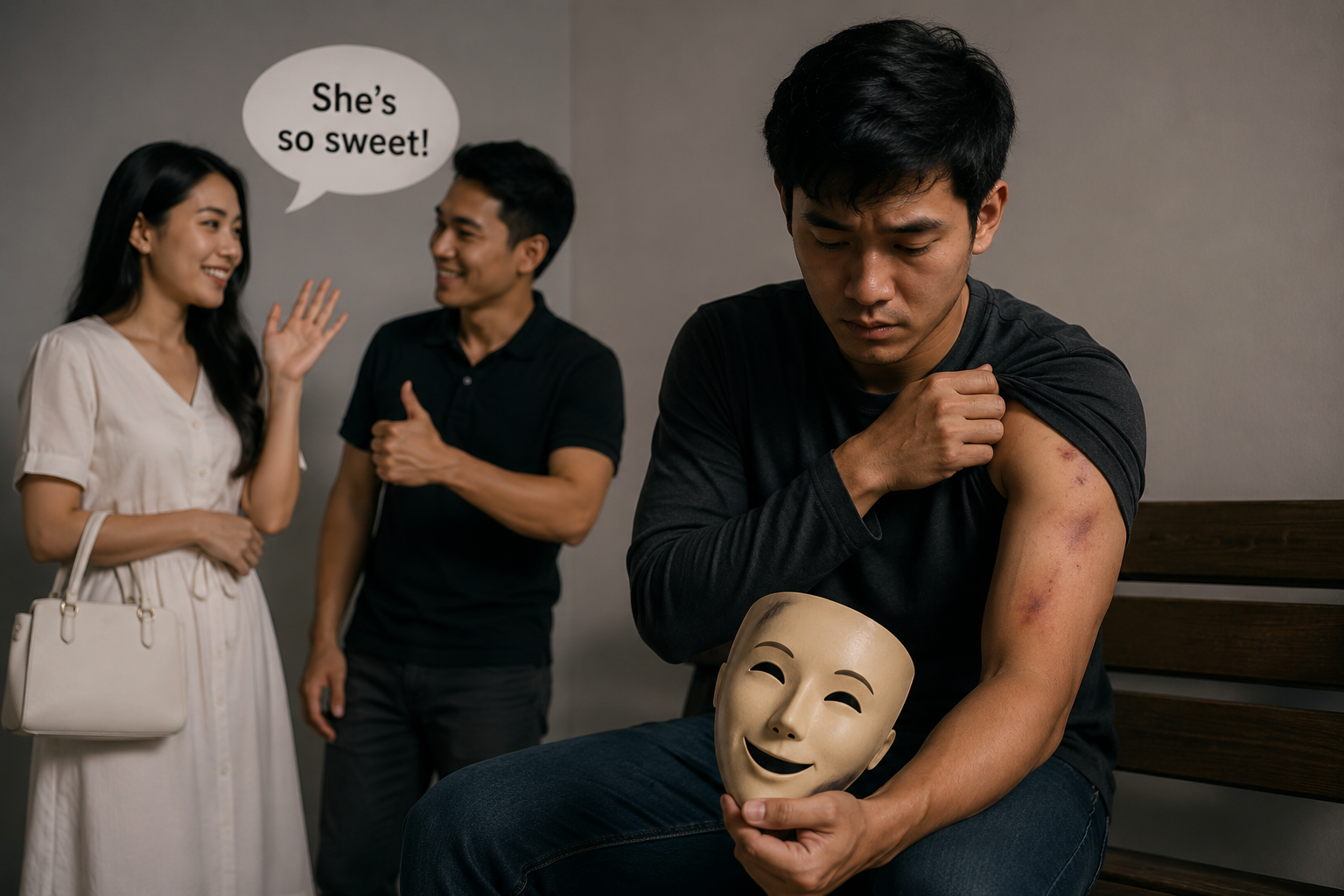
"She is so sweet."
"She is such a gentle person."
I would smile.
"Thank you."
Then I would go home.
And immediately check whether she was in a good mood.
Because the woman everyone thought was made of cotton could turn into a professional wrestler when she was angry.
Mali had a very specific method of expressing displeasure.
She pinched.
Not a little pinch.
Not the playful kind.
I mean the kind of pinch that made you question whether your skin had personally offended her.
If I said something she did not like, pinch.
If I forgot something, pinch.
If I came home late, pinch.
If I looked at her with the wrong facial expression, apparently my face needed correcting.
The problem was that Mali was very strategic.
She never did it where people could see.
So whenever I went outside, I wore long sleeves.
In the middle of summer.
People thought I was fashionable.
One neighbor even told me, "Tawan, I like your style. You always dress so elegantly."
I wanted to tell him, "Thank you. It is called survival fashion."
Instead, I smiled.
The worst part was that I was embarrassed.
I kept thinking about what people would say if I told them what was happening.
A man being abused by his girlfriend?
People would laugh.
They would tell me to "man up."
Someone would probably ask me what I had done to make her angry.
So I stayed quiet.
Whenever someone asked how things were going, I said:
"Great."
Meanwhile, my left arm looked like it had been used as a stress ball.
Then came the day I finally broke.
It started with a missing phone charger.
I had no idea why this charger became the most important object in Thailand that afternoon, but apparently it was.
Mali asked where it was.
I said I did not know.
She looked at me.
I looked at her.
She looked at me again.
I immediately started searching.
Under the couch.
Behind the television.
Inside drawers.
At one point, I checked the refrigerator.
I do not know why.
Fear makes people innovative.
Eventually, I found the charger.
It was in her handbag.
I showed it to her.
She looked at it.
Then she looked at me.
Then she said, "Why did you not look there first?"
I knew at that exact moment that something inside me had finally snapped.
That evening, I called my friend Niran.
When he answered, I whispered:
"Niran."
"What happened?"
"Things are not as they seem."
There was silence.
Then he asked, "Are you okay?"
"No."
"Is she there?"
"Yes."
"Can you talk?"
"No."
"Can you text?"
"Yes."
"Then text me."
So I did.
HELP.
He arrived the next morning.
I showed him the bruises on my arms.
His face changed immediately.
He looked at me.
Then at my long sleeves.
Then back at me.
"Tawan."
"Yes?"
"Why did you never tell me?"
I shrugged.
"What were people going to say?"
Niran stared at me.
Then he said something I will never forget.
"People are already saying things."
Apparently, Mali had already started telling everyone that I was unstable.
According to her version of events, I had suddenly become emotionally disturbed.
I was "having problems."
I was "under pressure."
I was "not myself."
And, apparently, I had simply abandoned her for no reason.
The neighborhood was devastated.
Not for me.
For her.
People called me.
"Tawan, how could you leave her like that?"
"She loved you."
"She did everything for you."
"She looks heartbroken."
One woman actually told me, "You should be ashamed of yourself. Look at what you have done to that poor girl."
I looked at her.
Then I looked at my long sleeves.
Then I said:
"Yes. I am ashamed."
She nodded sympathetically.
I continued:
"I am ashamed I did not leave sooner."
She did not know what to say.
Neither did I.
So I left.
For the first time in a long time, I packed a bag without wondering whether somebody would be angry about it.
I left behind the relationship.
I left behind the explanations.
And, most importantly, I left behind the neighborhood's opinions.
For weeks, people still talked.
Some said I had abandoned Mali.
Some said I had lost my mind.
Some said I had been selfish.
One person even said, "He probably just could not handle a strong woman."
I almost laughed.
A strong woman?
That woman could have pinched the strength out of a professional boxer.
But eventually, the gossip stopped.
And I started healing.
I learned that abuse does not always look the way people expect it to look.
Sometimes the person everyone describes as "so sweet" is hurting someone behind closed doors.
Sometimes the person everyone assumes is the problem is the person who has been quietly surviving.
And sometimes you have to stop worrying about what people will say and start worrying about what staying is doing to you.
These days, I wear short sleeves.
I enjoy them.
I even bought a few shirts specifically because I could.
Whenever someone asks why I suddenly stopped wearing long sleeves, I just smile.
Then I say:
"I finally found the courage to dress for the weather."
And that is the closest I come to explaining the whole story.
What this experience taught me
It taught me that appearances can be incredibly misleading. I spent too much time worrying about what people would think instead of paying attention to what was actually happening to me. I also learned that being a man does not make abuse less serious and asking for help does not make me weak.
Advice to others
Do not let embarrassment or other people's opinions keep you trapped. If someone is hurting you, take it seriously, even if everyone else thinks that person is wonderful. You do not have to prove your pain to an audience before you are allowed to leave.
And if you ever find yourself wearing three layers of clothing in 35-degree weather because you are afraid somebody will see what is happening at home, consider that a fairly strong hint that it is time to make a change.